Cyndy Thooi

Bernal Lecture 2024 at Birkbeck, 9th May

When: — Venue: Birkbeck Clore Management Centre

Book your place

The School of Natural Sciences at Birkbeck are delighted to invite you to this annual lecture in memory of Professor JD Bernal.
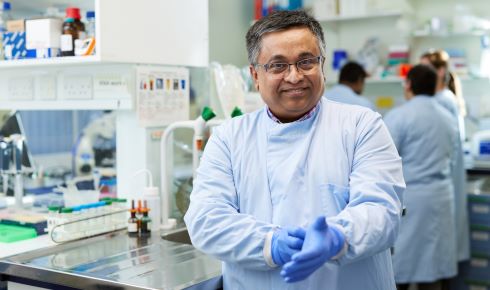
Established in 1968, this annual lecture commemorates JD Bernal – Professor of Physics at Birkbeck from 1938 and then Chair of Crystallography in 1963. In line with Bernal’s interests in structural biology, X-ray crystallography and, especially, the social consequences of science, this year we are pleased to welcome Professor Ravindra Gupta, Professor of Clinical Microbiology at the Cambridge Institute for Therapeutic Immunology and Infectious Diseases, University of Cambridge, for a talk titled “SARS CoV-2 : keeping up with an unprecedented pathogen“.

The SARS CoV-2 pandemic was unique in many ways, and the virus continues to surprise us with its ability to adapt and evolve. This is driven largely by an ability to persist in immune compromised individuals. In this talk we will explore how variants of concern arise and how we can stay ahead to prevent ongoing morbidity and mortality

This event is free to attend but booking is essential.

Posted by Cyndy Thooi in Events
Prof Finn Werner’s group published paper in Nature Communications – Idiosyncratic chromatin regulates adaptive immunity in archaea at the level of transcription

Prof Finn Werner’s group published paper in Nature Communications – Idiosyncratic chromatin regulates adaptive immunity in archaea at the level of transcription

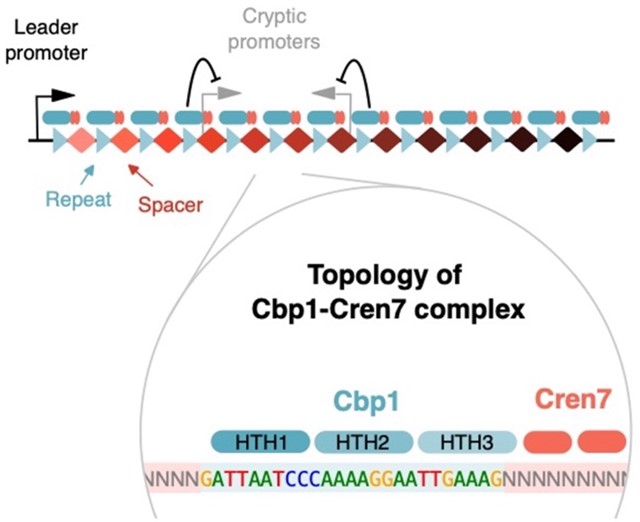
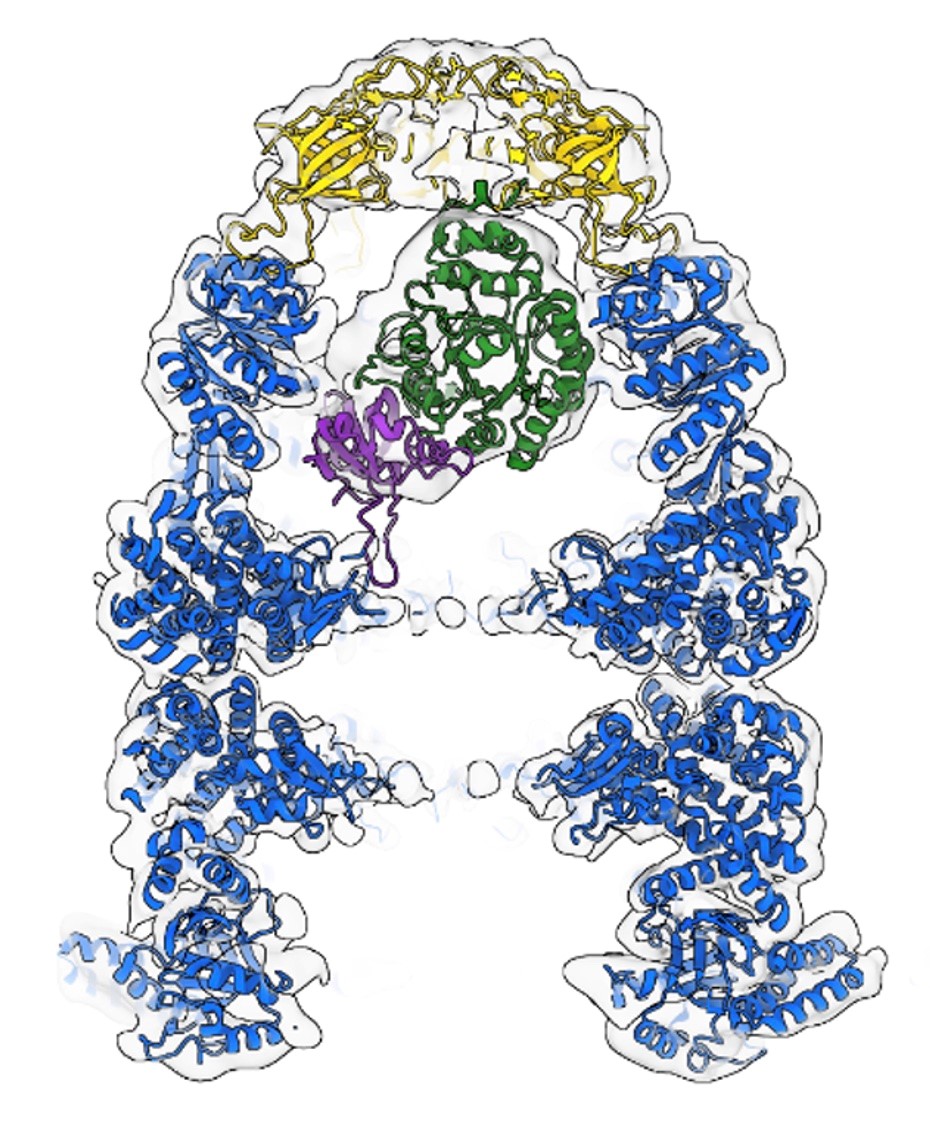
The prevalent state of DNA in all cells is chromatin that is made of protein-DNA complexes which are dynamic, complex and heterogenous. The exact composition of the chromatin determines its properties, how it regulates transcription and genome architecture. A breakthrough article by the RNAP laboratory at UCL published today in the journal Nature Communications describes how two chromatin proteins, Cbp1 and Cren7, collaborate to modulate gene regulation in opposing ways. While this type of specialised chromatin stimulates the expression of long crRNA arrays that facilitate adaptive immunity in archaea (‘CRISPR’), it cryptic promoters that frequently reside in the memory of the ‘immunity’ system, in the ‘CRISPR spacers’. This transcription interference by cryptic promoters limits how much spacer information can be stored in CRISPR arrays, or worse lead the malfunction of the system. Dr. Fabian Blombach from the ISMB RNAP laboratory, the lead author of the study, says ‘There is a lot of attention in the field to histones and their role in gene regulation, but we can learn so much from archaeal and bacterial chromatin proteins, including some of the ground rules that shape the interaction between chromatin proteins and transcription in all cellular life.’

Sulfolobus Cbp1 and Cren7 form chimeric chromatin structures on large archaeal CRISPR arrays. Cbp1 confers sequence-specificity and interacts via its HTH3 domain interactions with Cren7. Together, they enhance leader promoters but repress CRISPR spacer-encoded cryptic promoters1. Archaea research in the RNAP lab is funded by the Wellcome Trust Investigator in Science Award (WT207446/Z/17/Z).

References

  1. Blombach, F., Sykora, M., Case, J., Feng, X., Baquero, D.P., Fouqueau, T., Phung, D.K., Barker, D., Krupovic, M., She, Q., and Werner, F. (2024). Cbp1 and Cren7 form chromatin-like structures that ensure efficient transcription of long CRISPR arrays. Nat Commun 15, 1620. 10.1038/s41467-024-45728-8.

Full paper can be read here.

Posted by Cyndy Thooi in Publications
Prof Finn Werner’s group published paper in Nature Communications – Structure of the recombinant RNA polymerase from African Swine Fever Virus

Prof Finn Werner’s group published paper in Nature Communications – Structure of the recombinant RNA polymerase from African Swine Fever Virus

Finn Werner’s group published a paper in Nature Communications on 22nd February.

The paper studies the mechanism of how viruses enter and replicate in the hosts cells is of fundamental importance to understand how they cause disease and developing tools for control.

A team of scientists at UCL, led by Prof Finn Werner, have taken a major step forward in understanding how African swine fever virus (ASFV) genes are controlled are expressed. ASFV causes a fatal disease of domestic pigs and wild boar that results in severe socio-economic impacts in affected countries in Africa Europe, Asia and parts of Oceana and the Caribbean.  The lack of tools including vaccines or antivirals limits control of disease.

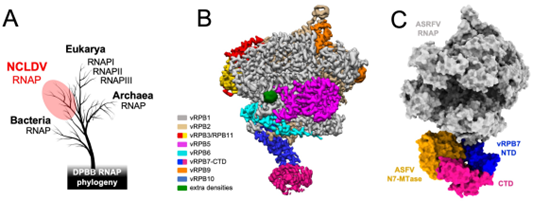
ASFV replicates in the host cell cytoplasm and uses its own machinery to transcribe its genes into mRNAs which are translated into proteins required for virus replication or modulating host cell function. The UCL team have expressed and assembled 8 proteins comprising the ASFV RNA polymerase into an active complex. The cryo-EM structure of this complex molecular machine was determined providing the information to further probe how it functions to regulate ASFV gene expression. Dr Pilotto says: ‘The production of recombinant eukaryotic RNA polymerases remains the bottleneck for structural studies and high-throughput inhibitor screenings. Our success with the ASFV RNAP represents a game-changer in the field’. The ASFV RNAP bears a striking resemblance to RNAPII – and key differences include the fusion of the ‘assembly platform subunits’ and an unusual fusion with a domain related to the eukaryotic mRNA capping enzyme. Together, the changes represent adaptions to streamline the enzyme to serve the virus best: allowing for efficient RNAP biogenesis, and mRNA expression and processing. The availability of a recombinant functional RNA polymerase will facilitate high throughput screening of antiviral compounds to identify compounds with sufficient specificity and selectivity.

This research will be further developed in a recently funded BBSRC collaborative research project between UCL and The Pirbright Institute (led by Drs Linda Dixon and Chris Netherton). This project will identify other accessory virus and host factors involved in regulating the temporal expression of ASFV genes and the packaging of the virus RNA polymerase into particles ready to start a next round of infection. This information is critical to understand the ASFV replication cycle and potential host factors that may limit virus replication.

Evolution and structure of ASFV RNAP. All DPBB RNAP share a common ancestry (A), the cryoEM structure of the 8-subunit ASFV RNAP (B), and model of the RNAP-capping enzyme complex showing the interaction with the CE (N7-MTase in orange, vRPB7 in blue/magenta) 1. ASFV research in the RNAP lab is funded by the BBSRC (BB/X015424/1) and Wellcome Trust (108877/B/15/Z).

Reference

  1. Pilotto, S., Sykora, M., Cackett, G., Dulson, C., and Werner, F. (2024). Structure of the recombinant RNA polymerase from African Swine Fever Virus. Nat Commun 15, 1606. 10.1038/s41467-024-45842-7.

Full paper can be read here.

Posted by Cyndy Thooi in Uncategorised
Kostas Thalassinos’ group published paper in Molecular & Cellular Proteomics (MCP) online

Kostas Thalassinos’ group published paper in Molecular & Cellular Proteomics (MCP) online

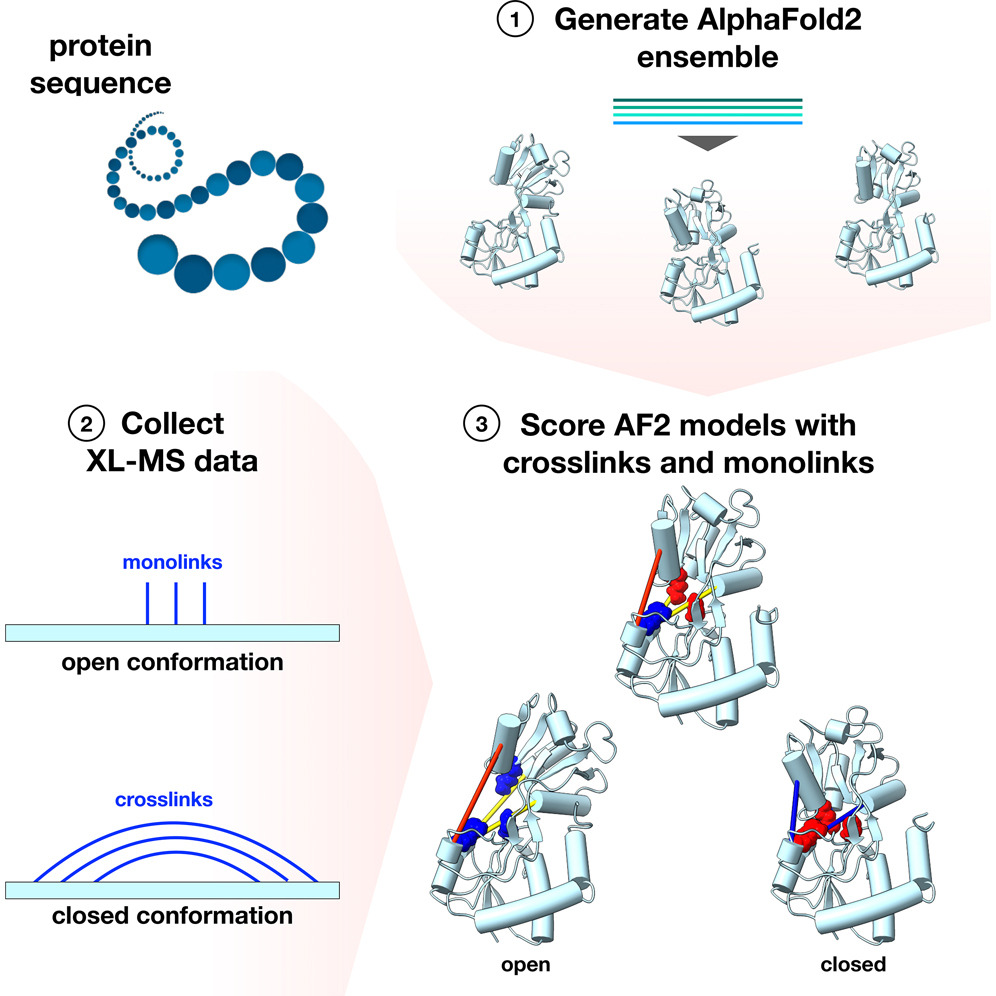
Together with the Topf lab at the Centre for Structural Systems Biology (Hamburg), Kish Adoni from the Thalassinos lab has developed a novel pipeline that incorporates crosslinking-mass spectrometry data into AlphaFold2 for improved accuracy of protein structure determination. They found this workflow to be of particular relevance to proteins that occupy multiple conformations. The function of a protein is determined by its structure, via the structure-function relationship, and thousands of proteins modify their shape upon external cues such as molecular or protein interactions. As such, probing these conformational modifications is pivotal to characterising the protein’s behaviour, for example in the context of drug design when developing pharmaceuticals for drug-protein interactions.

Full paper can be read here.

Posted by Cyndy Thooi in Publications
Professor Sanjib Bhakta’s lab featured in The Biologist

Professor Sanjib Bhakta’s lab featured in The Biologist

Professor Sanjib Bhakta (School of Natural Sciences, Faculty of Science, Birkbeck) and his research lab has been featured in the The Royal Society of Biology’s magazine, The Biologist. Full article can be accessed here.

Posted by Cyndy Thooi in Lab news
Franca Fraternali’s group published paper in Nature Methods

Franca Fraternali’s group published paper in Nature Methods

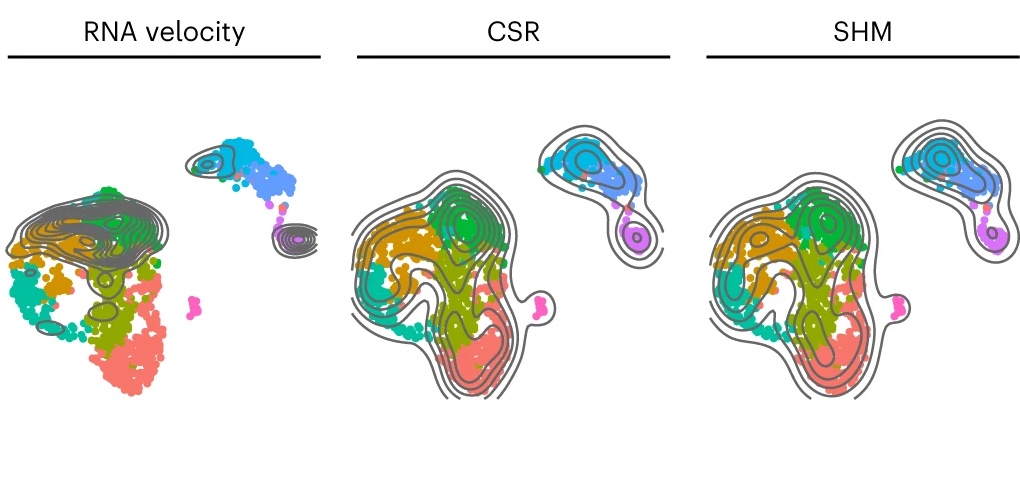
Dr Joseph Ng and Prof. Franca Fraternali have published the novel method sciCSR to analyse CSR (class-switch recombination) and the antibody response by using molecular data from single B-cells (Nature Methods)

sciCSR allows researchers to analyse in high detail how CSR occurs across time. By building mathematical models to infer CSR events probabilistically, sciCSR can be applied in scenarios including vaccination and gene knockouts and to predict how antibody responses are mounted against immune challenges.

Posted by Cyndy Thooi in Publications
Josie Ferreira awarded the Wellcome Career Development Award

Josie Ferreira awarded the Wellcome Career Development Award

ISMB’s Josie Ferreira was recently awarded the Wellcome Career Development Award.

The CDA is an 8 year award for Josie to start her own research group at the ISMB, based in UCL. Josie’s award proposal was titled “How does the malaria parasite transform its unique cytoskeleton to ensure disease transmission?”

Josie’s research uses in situ structural biology techniques to study the parasite that causes the most severe form of malaria in humans, Plasmodium falciparum. In her previous work, she studied an essential cellular component; the parasite’s microtubule cytoskeleton. Studying this within the native parasite cell, revealed that P. falciparum has microtubules which are evolved to undertake specific roles in different life cycle stages. These microtubules have structures that are strikingly different from the well-studied canonical microtubules in vertebrates. This work highlights the extreme adaptations that this parasite has undergone and exposes unique biology in P. falciparum which has diverged from that of its host. Her lab will continue with this work, dissecting the structure, role and biological significance of the non-canonical microtubules, focussing on those which are required for the transmission of the parasite from its human host to the mosquito vector.

We would like to take this opportunity to congratulate Josie for her achiement.

Posted by Cyndy Thooi in Achievements
Generative AI Day for Life Sciences London, 19th October 2023

Generative AI Day for Life Sciences London, 19th October 2023

NVIDIA is hosting an event about AI in drug discovery. Discuss your next AI breakthroughs across topics like drug discovery, medical image analysis, genomics and personalized medicine, and more. The half-day event begins with check-in at 4pm and ends with an opportunity to network with experts at 8pm.

There will be demos & learning sessions about LLMs for biomolecular design. Vice President of NVIDIA Healthcare, Kimberly Powell, will moderate a panel with Laksh Aithani (CEO from Charm Therapeutics), Dr. Lindsay Edwards (CTO from Relation Therapeutics) and Nihal Sinha (Partner at F-Prime Ventures).

            Reserve your seat on https://events.nvidia.com/healthgenaidaylondon.

Location will be shared once your seat is confirmed.


Posted by Cyndy Thooi in Events