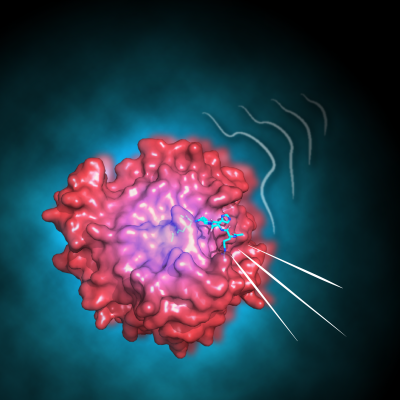
Flemming Hansen’s research group published a paper titled ‘Intrinsic structural dynamics dictate enzymatic activity and inhibition’ in the Proceedings of the National Academy of Sciences (PNAS) Journal on 2 October 2023.
The full paper is available here.
Cyndy Thooi
Josie Ferreira awarded the Wellcome Career Development Award
ISMB’s Josie Ferreira was recently awarded the Wellcome Career Development Award.
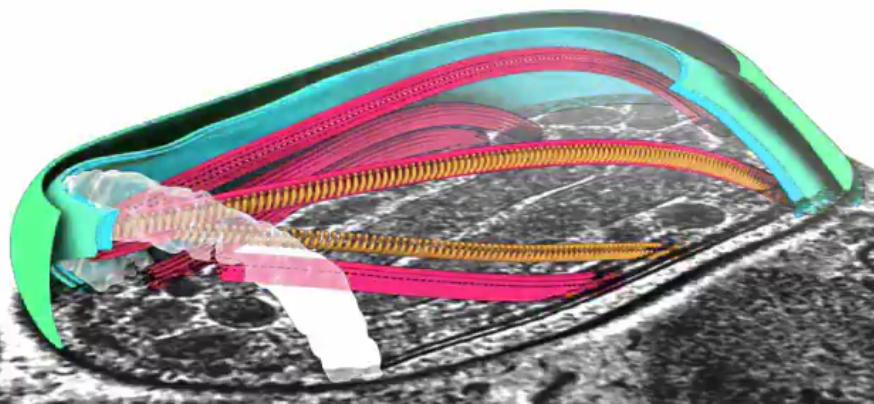
The CDA is an 8 year award for Josie to start her own research group at the ISMB, based in UCL. Josie’s award proposal was titled “How does the malaria parasite transform its unique cytoskeleton to ensure disease transmission?”
Josie’s research uses in situ structural biology techniques to study the parasite that causes the most severe form of malaria in humans, Plasmodium falciparum. In her previous work, she studied an essential cellular component; the parasite’s microtubule cytoskeleton. Studying this within the native parasite cell, revealed that P. falciparum has microtubules which are evolved to undertake specific roles in different life cycle stages. These microtubules have structures that are strikingly different from the well-studied canonical microtubules in vertebrates. This work highlights the extreme adaptations that this parasite has undergone and exposes unique biology in P. falciparum which has diverged from that of its host. Her lab will continue with this work, dissecting the structure, role and biological significance of the non-canonical microtubules, focussing on those which are required for the transmission of the parasite from its human host to the mosquito vector.
We would like to take this opportunity to congratulate Josie for her achiement.
Generative AI Day for Life Sciences London, 19th October 2023
NVIDIA is hosting an event about AI in drug discovery. Discuss your next AI breakthroughs across topics like drug discovery, medical image analysis, genomics and personalized medicine, and more. The half-day event begins with check-in at 4pm and ends with an opportunity to network with experts at 8pm.
There will be demos & learning sessions about LLMs for biomolecular design. Vice President of NVIDIA Healthcare, Kimberly Powell, will moderate a panel with Laksh Aithani (CEO from Charm Therapeutics), Dr. Lindsay Edwards (CTO from Relation Therapeutics) and Nihal Sinha (Partner at F-Prime Ventures).
Reserve your seat on https://events.nvidia.com/healthgenaidaylondon.
Location will be shared once your seat is confirmed.
Vilde Leipart awarded Alf Bjørseth’s Inspiration Award
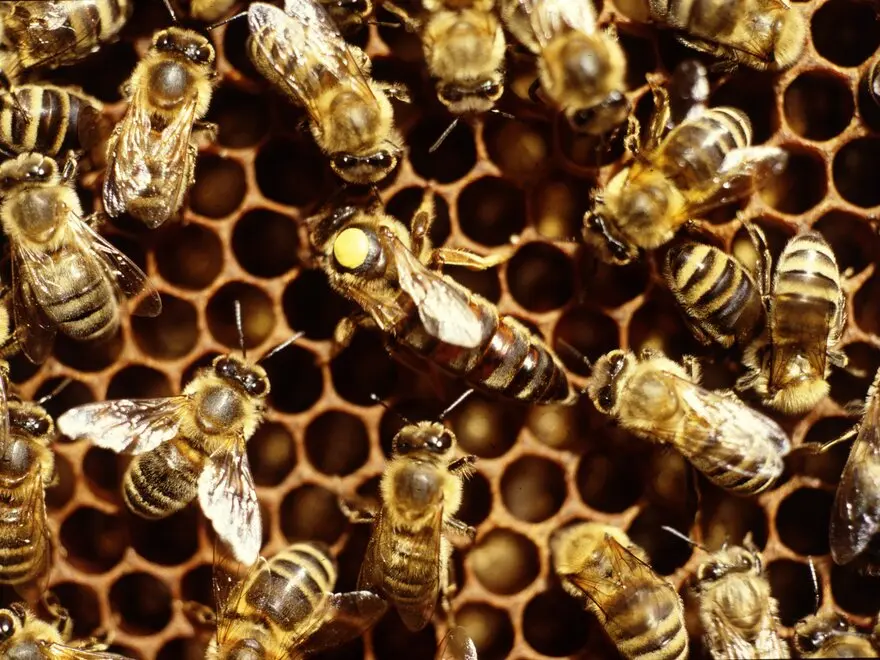
Vilde Leipart has been awarded Alf Bjørseth’s Inspiration Award for her doctoral work, entitled “Understanding the structure-function relationship of honey bee Vitellogenin”. Her research examined the protein vitellogenin in honey bees by using artificial intelligence – an article summarising her research was published in the Norwegian University of Life Sciences.
Full article of Vilde’s award can be read here.
Vilde is currently a postdoc working in Christine Orengo’s and Franca Fraternali’s labs, continuing her work on Vitellogenin with the aim to boost honey bee health.
ISMB Special Event: Prof. Enrico Bucci, 27th September 2023
We are pleased to announce an ISMB Special Event taking place on Wednesday, 27th September 2023.
Title: The Industry of Science Fraud
Guest speaker: Prof. Enrico Bucci, Temple University College of Science and Technology
Host: Prof. Franca Fraternali
Date: 27 September 2023
Time: 2-3pm
Venue: JZ Young Lecture Theatre, Anatomy Building
Format:
The event will kick off with an introduction by Prof. Franca Fraternali, the Director of ISMB. Prof. Enrico Bucci will deliver a talk about “The industry of science fraud”. The talk will be followed by a discussion and a Q & A session, steered by Prof. Fraternali and Prof. Kostas Thalassinos. There will be drinks and a networking session at the end of the event.
Everyone is welcome to attend, we look forward to seeing you all at the Special Event!
ISMB LiDO Showcase, 26th September 2023
The ISMB LiDO showcase will be held on Tuesday, 26th September 2023, from 11am to 4pm. Venue of the showcase is Room MAL G16, Birkbeck main building.
The event will start with a welcome coffee at 11am, followed by an introduction to ISMB by Prof. Franca Fraternali, Director of ISMB.
There will be multiple 10 min presentations by a diverse group of PIs through out the day, ending at 4pm.
Seminar by Dr Stephen Fried from John Hopkins University on 18th September 2023
Christine Orengo and John Christodoulou will be hosting a seminar by Dr Stephen Fried on 18th September 2023.
Speaker: Dr Stephen Fried, John Hopkins University
Date: Monday, 18th September 2023
Time: 1-2pm
Location: Birkbeck Central Building, Room BCB307
Title: How to Fold Every Protein – Proteome-Wide Measurements of Folding Call for a Post-Anfinsen Paradigm
Abstract:
Though protein folding has been at the heart of biophysical research for several decades, our knowledge of the topic is deep but narrow – we “know” a lot about a sparse set of “model” proteins that conform to Anfinsen’s thermodynamic hypothesis. Leveraging the power of structural proteomics, work in our lab has endeavored to interrogate protein folding and refolding globally, sensitively, and (for some applications) in vivo. We found that many E. coli proteins cannot efficiently return to their native structures following complete denaturation, and nonrefoldable proteins over-represent a particular set of biophysical and topological features that have been traditionally excluded from folding research. Proteins from yeast are strikingly more refoldable than E. coli proteins despite their greater size and complexity, a difference that we find can be attributed to the higher levels of intrinsic disorder in yeast proteins and their requirement for facile retrieval from biomolecular condensates. Nonrefoldability is connected to and explains a broad range of phenomena, such as the requirement of certain proteins to fold cotranslationally and kinetic stability, and may explain – in part – the molecular basis of cognitive decline associated with aging.
About the speaker:
Stephen Fried is a native of Kansas City. He received two S.B. degrees (2009) from MIT in chemistry and physics and completed his doctoral training at Stanford under the mentorship of Prof. S. G. Boxer in 2014. As a graduate student, Stephen’s research focused on understanding the physical principles underpinning enzymes’ catalytic power. From 2014 to 2018, Stephen was a Junior Research Fellow of King’s College and conducted research at the MRC Laboratory of Molecular Biology in Cambridge, United Kingdom. In Cambridge, his research focus shifted to chemical and synthetic biology. Stephen joined the Department of Chemistry at Johns Hopkins University in 2018 as an Assistant Professor, where he also holds appointments in the Departments of Biophysics and Biology. His lab develops and applies tools in structural proteomics to study protein folding globally, sensitively, and with high structural resolution. Stephen has been the recipient of the HFSP Young Investigator Award, NIH Director’s New Innovator Award, and a Cottrell Scholarship. In 2023, he was named a Future of Biophysics speaker by the Biophysical Society.

Professor Kostas Thalassinos’ group published paper in the Nature Journal
Professor Kostas Thalassinos’ research group published a paper titled ‘Genomic investigations of unexplained acute hepatitis in children’ in the Nature Journal on 30 March 2023.
The full paper is available here.
Professor Helen Saibil’s group published papers in The Nature Communications, The EMBO Journal and Nature Chemical Biology
Professor Helen Saibil’s research group published a paper titled ‘Structural journey of an insecticidal protein against western corn rootworm’ in Nature Communications on 13 July 2023. The full paper is available here.
Her group published two other papers recently, the paper titled ‘Structural basis of ubiquitin-independent PP1 complex disassembly by p97’ was published in The EMBO Journal on 2 June 2023. The full paper is available here.
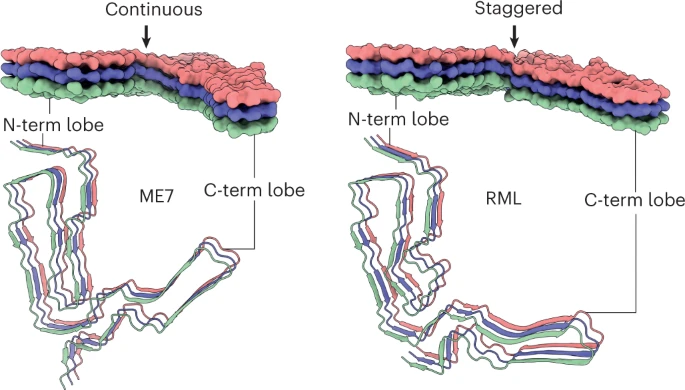
Finally, a paper on ‘A structural basis for prion strain diversity’ was published in the Nature Chemical Biology on 16 January 2023. The full paper is available here.
Special Seminar by Thomas Löhr, Molecular AI group at AstraZeneca, on Monday 19th June
Everyone is invited to a special ISMB seminar given by Dr Thomas Löhr from the Molecular AI group at AstraZeneca. This seminar is hosted by Gabriella Heller.
Speaker: Dr Thomas Löhr
Title: Computational tools to study disordered proteins, small molecules, and their interactions
Date & Time: 19th June, 3-4pm
Location: Anatomy Building, Room 249
Abstract: Disordered proteins and regions are highly prevalent in the human proteome, and are often implicated in disease. However, methods to study these systems in detail are lacking, and the potential for thermodynamic and kinetic characterisation using experimental methods is limited. Molecular simulations and associated analysis methods have advanced to the point where investigating disordered proteins and their interactions with other (bio-) molecules on an atomistic scale is now possible. I will first talk about the use of integrative structural methods to study systems ranging from small disordered peptides to large amyloid fibril fragments using data from nuclear magnetic resonance and cryo-EM. By combining a Bayesian approach (Metainference) with enhanced sampling techniques (Metadynamics) we are able to efficiently acquire a conformational ensemble of systems that would otherwise remain elusive. Next, I will present work to determine the kinetics of Amyloid-β 42, an aggregation-prone biomolecule implicated in Alzheimer’s disease, and its interactions with small molecules. By dynamically binding to the disordered monomeric state of the protein, a drug-like molecule can slow downstream aggregation processes, demonstrating the feasibility of directly drugging dynamic biomolecules. This was accomplished using ultra-long timescale molecular dynamics simulations combined with a deep-learning based Markov model approach. Finally, I will explain ongoing efforts to integrate molecular dynamics and similar approaches into automated drug discovery pipelines to improve our coverage of chemical space and make the design-make-test-analyze cycle more efficient by guiding small molecule generative models.