Cyndy Thooi

Protein Annotations in the age of AI

Protein Annotations in the age of AI

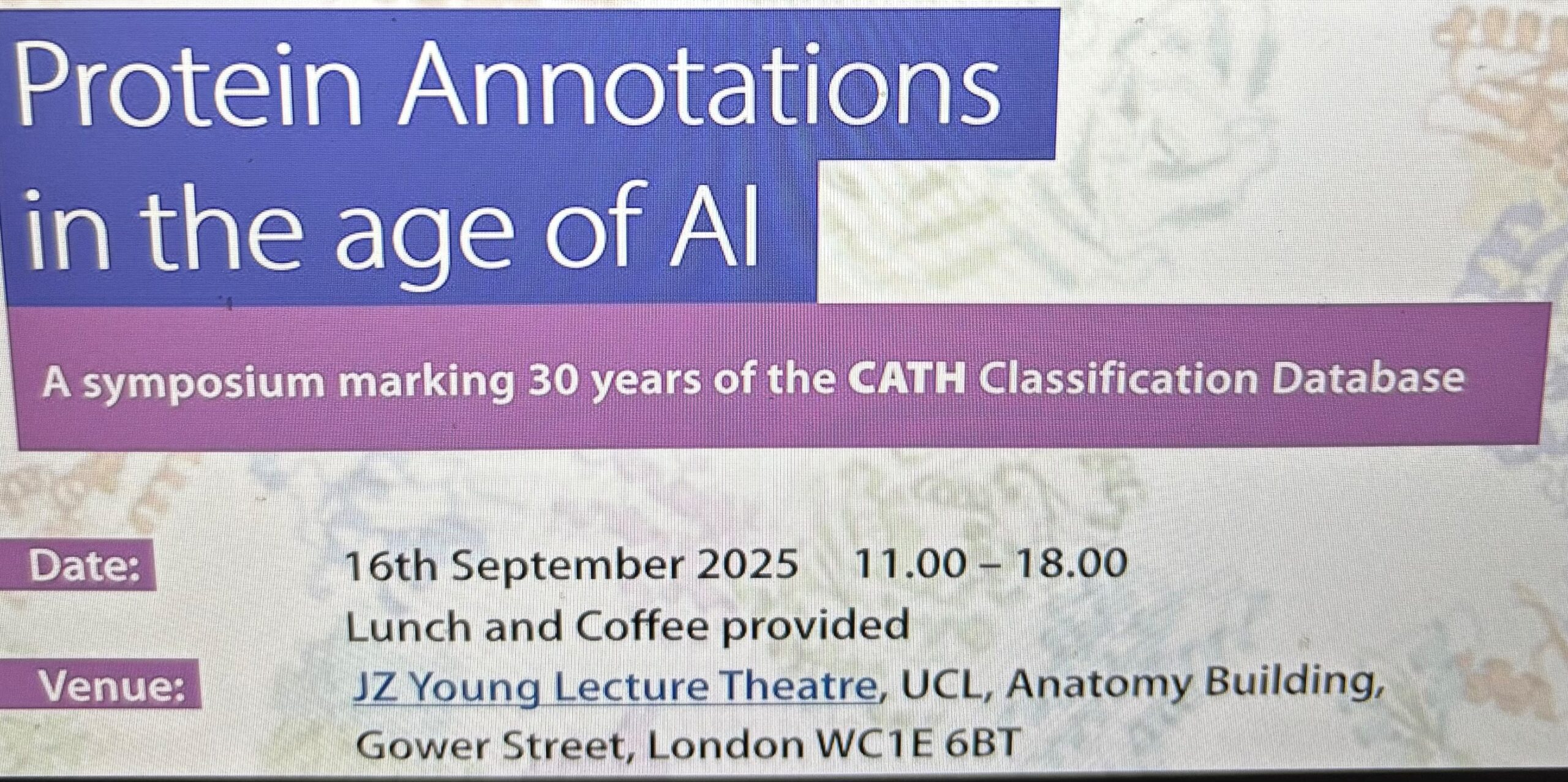
A not-for-profit symposium highlighting recent AI-based developments to enhance protein family classifications, annotations and analyses. There will be talks from world leaders in structural bioinfomatics on various themes including pioneering protein language models and key international resources including: PDBe, InterPro, UniProt, MGnify, SWISS-MODEL, FrustraEvo and CATH.

Invited Speakers:

  • Christine Orengo — University College London
  • Burkhard Rost — Technical University, Munich, Germany
  • Janet Thornton — European Bioinfomatics Institute, Cambridge
  • David Jones — University College London
  • Gonzalo Parra — Barcelona Supercomputer Centre, Spain
  • Sameer Velankar — European Bioinfomatics Institute, Cambridge
  • Alex Bateman — European Bioinfomatics Institute, Cambridge
  • Maria Martin — European Bioinfomatics Institute, Cambridge
  • Rob Finn — European Bioinfomatics Institute, Cambridge
  • Gerardo Tauriello — Biozentrum, Basle, Switzerland
  • Alexey Murzin — Laboratory of Molecular Biology, Cambridge

If you wish to showcase your research with a poster presentation, please submit a 300-words or less abstract (including references) to Dr. Vaishali Waman at v.waman@ucl.ac.uk before 1st September.

Note: the £10 charge for tickets contributes towards the cost of 2 coffee breaks and lunch.

Posted by Cyndy Thooi in Uncategorised
Swiss Government Excellence Scholarships 2026/27 for British researchers

Swiss Government Excellence Scholarships 2026/27 for British researchers

The Swiss government offers fellowships for British researchers to undertake a research project in Switzerland.

Switzerland has some of the world’s top universities and research institutes © Switzerland Tourism / Lorenz Richard The Swiss Government Excellence Scholarships give early-stage British researchers (Master’s degree or recent PhD) the opportunity to pursue a research project at postgraduate, doctoral or postdoctoral level at any of Switzerland’s universities or national research institutes. Applicants need to propose a research project that is supported by an academic supervisor at their institution of choice. Maximum duration is 12 months for research projects and 36 months for pursuing a PhD. The application deadline for Scholarships commencing in September 2026 is 5 December 2025.

Details and application guidelines.

For further information please contact Dr Lutz-Peter Berg (lutz-peter.berg@eda.admin.ch) at the Embassy of Switzerland in London.

Posted by Cyndy Thooi in Uncategorised

Engineering plants and algae into next-generation crops

Potato farmA new project led by UCL seeks to develop the plants and food of the future, supported by UK government funding from the Advanced Research and Invention Agency (ARIA).
Professor Saul Purton (UCL Structural & Molecular Biology) and Dr Scott Lenaghan (University of Tennessee) are co-leading a project, supported by an £8.9 million grant, that aims to harness the power of organisms that capture energy from sunlight (photosynthesis) – both land plants and algae – for the sustainable, affordable, and accessible production of valuable compounds for healthcare and manufacturing.


Read the full article here.

Posted by Cyndy Thooi in Uncategorised

TwinsUK: a study of health and ageing from cells to society

TwinsUK is the UK’s largest study of adult twins who have contributed their health data over up to 30 years. Claire Steves, together with twins involved in the studies – Yvonne Haines and Sandra Coles, will talk about how this collaboration between scientists and participants has contributed to understanding of how we can stay healthy as we age.

Posted by Cyndy Thooi in Uncategorised

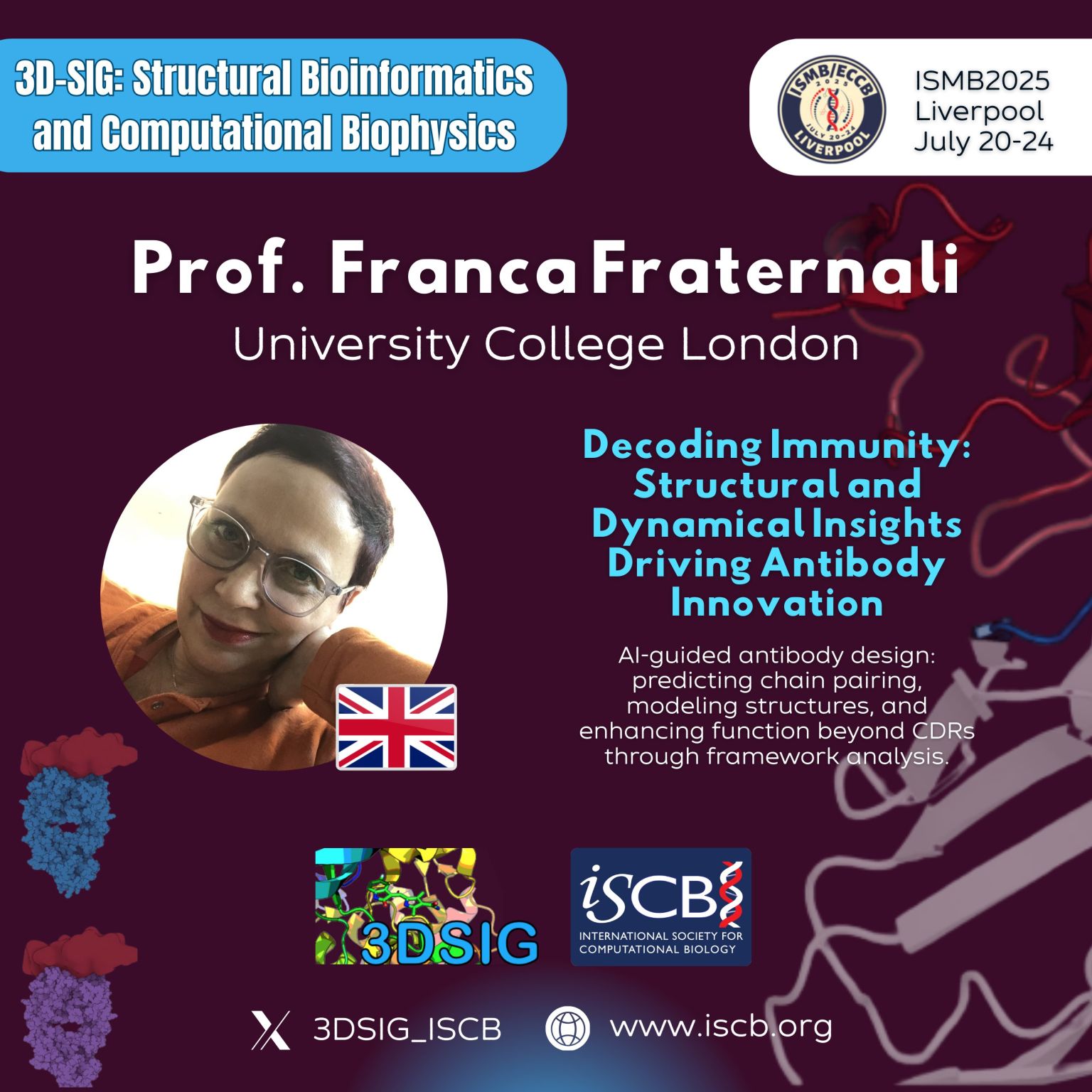
Franca Fraternali Keynote Speaker at 3DSIG/ISMB 2025 in Liverpool

Happy to announce that Prof. Franca Fraternali as a Keynote speaker this year at 3DSIG/ISMB in Liverpool! Prof. Fraternali will present cutting-edge AI and structure-based strategies for antibody design, from chain pairing prediction to beyond-CDR engineering.

You can still register to attend the conference and stay updated about the latest developments in Structural Bioinformatics and Computational Biophysics!

Find more information on the conference: https://www.iscb.org/ismbeccb2025/home

Posted by Cyndy Thooi in Uncategorised

Frances Brodsky elected a member of the American Academy of Arts and Sciences

frances brodskyCongratulations to Professor Frances Brodsky on being elected a member of the American Academy of Arts and Sciences in the Cellular and Developmental Biology Section of Biological Sciences, in recognition of her outstanding scientific and leadership achievements.

We are proud to see Frances join the ranks of such distinguished individuals whose, in the words of Academy President L.L. Patton, “accomplishments speak volumes about the human capacity for discovery, creativity, leadership, and persistence. They are a stellar testament to the power of knowledge to broaden our horizons and deepen our understanding.”

Frances’s research focuses on membrane traffic in cells, and on the structure and function of clathrin and adaptor proteins that regulate these processes in health and disease.

Find out more about the Brodsky lab: https://www.ucl.ac.uk/biosciences/structural-and-molecular-biology/brodsky-lab/ 

Posted by Cyndy Thooi in Uncategorised

Thalassinos Lab at UCL Characterises the Structure of a Disease-Associated Conformational Intermediate of Alpha-1-Antitrypsin

For the past 15 years at UCL, the Thalassinos Lab has been studying alpha-1-antitrypsin, focusing on understanding the early misfolding events and how monomers form higher-order oligomers. Despite numerous models reported in the literature, the formation of the dimer as the first step towards higher-order oligomers has always been intriguing, with many different models of the dimer being reported.

Using a combination of cyclic ion mobility and top-down electron capture dissociation, the team has identified and characterised an intermediate misfolded metastable state, where approximately 12% of the molecule at the C-terminus is displaced. Their data supports a polymer mediated by an intermolecular C-terminal domain insertion but also establishes a previously unobserved progression of pathogenic structural changes, thus extending the mechanism of alpha-1-antitrypsin polymerization. Importantly, this intermediate was also observed in alpha-1 protein extracted from human tissue.

Previous proposed intermediates were extrapolated from in vitro studies using methods that study the bulk average. The unique ability of ion mobility mass spectrometry to separate co-existing conformers and perform native top-down fragmentation, along with performing these analyses on ex vivo material, has been crucial. This highlights the power of ion mobility for studying early misfolding events.

The Thalassinos Lab extends their gratitude to the Irving and Lomas labs for their collaboration, and all the patients who provided material for this study. 

For more information: https://pubs.acs.org/doi/epdf/10.1021/jacs.4c18139?ref=article_openPDF

Posted by Cyndy Thooi in News, Publications
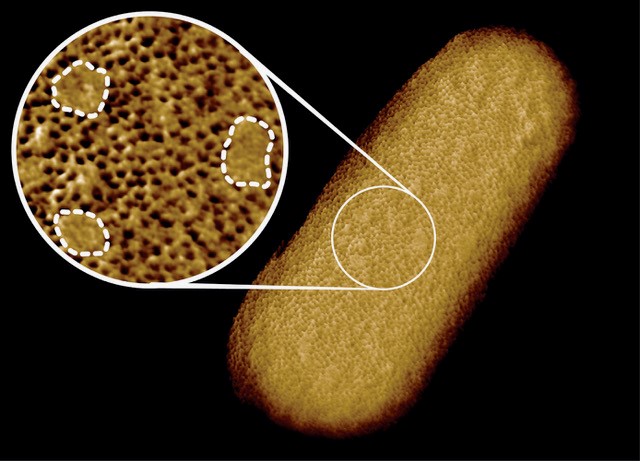
Brian Ho’s group published paper in PLOS Journal

Brian Ho’s group published paper in PLOS Journal

Brian Ho’s group recently published a paper in PLOS Journal on 18th July 2024.

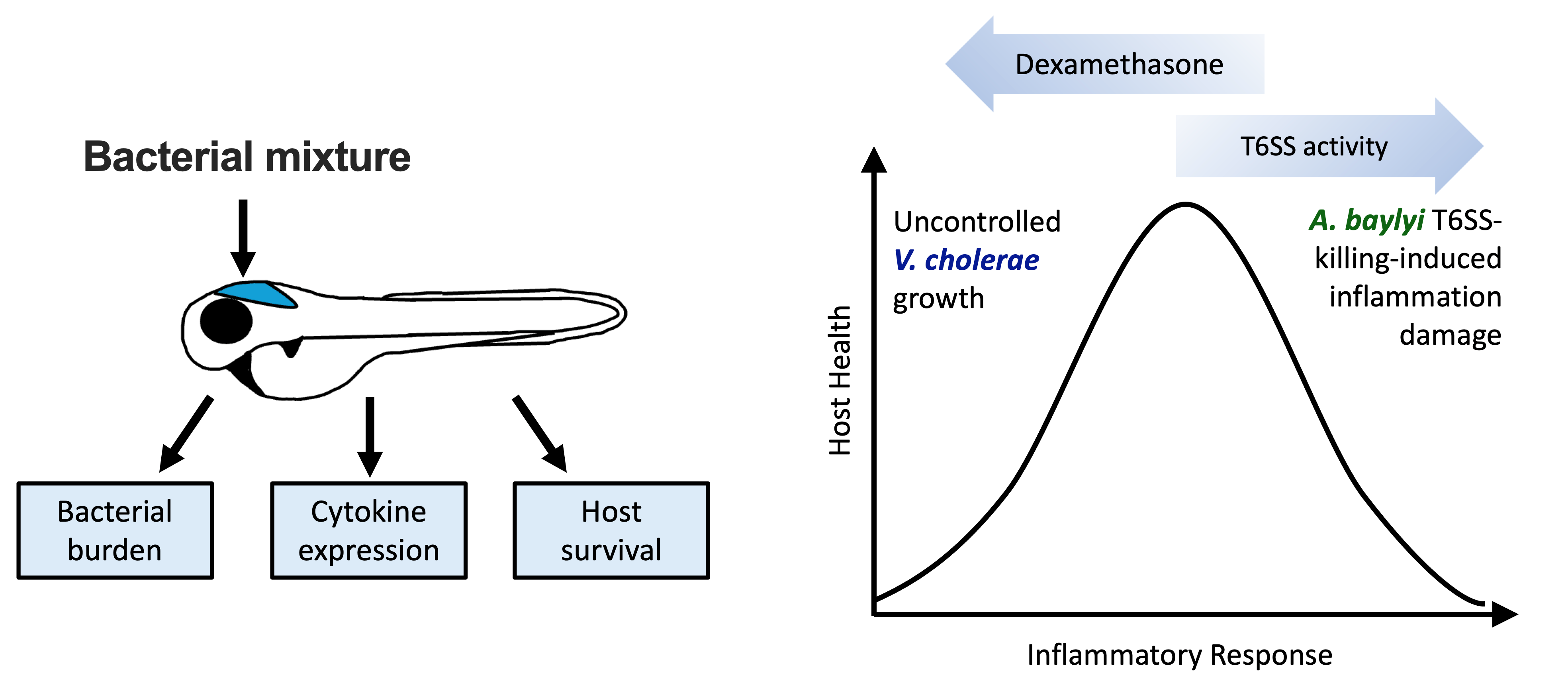
Interbacterial competition plays an important role in the dynamics of microbial communities, however the impact of such competition on host defenses is less clear. In this work, we use a zebrafish model to reductively investigate the host response to distinct forms of bacterial antagonism in well-defined bacterial communities. We looked at bacterial killing mediated by the type VI secretion system (T6SS) and observed that this form of bacterial antagonism resulted in prolonged inflammatory responses and an increase in host death, independent of any specific effector or bacterial species. By contrast, bacterial killing mediated by colicins, despite being significantly more efficient in eliminating sensitive bacteria, induced minimal host responses, resulting in a substantially better host outcome. Altogether, these results provide insight into the roles of different antibacterial systems that pathogens and commensals use inside their host.

Full paper can be accessed here.

Posted by Cyndy Thooi in Publications