Uncategorised

£49.35m for mass spectrometry infrastructure

£49.35m for mass spectrometry infrastructure

A bid team which included UCL’s Professor Konstantinos Thalassinos has secured £49.35m from the UKRI Infrastructure Fund to establish a nationwide mass spectrometry infrastructure.

Critical Mass UK (C-MASS) will be a national hub-and-spoke infrastructure that will integrate and advance the UK’s capability in mass spectrometry, a technique that identifies the characteristics of molecules.

Mass spectrometry is used across a wide range of scientific research and C-MASS will enable large-scale screening and accelerated data access and sharing.

It will bring together cutting-edge instrumentation at a range of laboratories connected by a coordinating central hub that will manage a central metadata catalogue.

This will enable researchers to enhance their understanding of new materials required for quantum technologies, semiconductors, batteries, catalysts, medicines and more.

C-MASS will also be a critical health resource for the UK, for example by allowing researchers to combine datasets leading to key information about respiratory health from patients’ blood which can be compared with data on air quality.

Professor Konstantinos Thalassinos, academic lead of the UCL Mass Spectrometry Science Technology Platform, said: “I am thrilled by the funding secured for this groundbreaking mass spectrometry infrastructure. This investment will equip numerous labs across the UK with state-of-the-art mass spectrometers, fostering a collaborative approach to tackle significant challenges that are beyond the reach of any single lab.

“A cornerstone of this initiative is the establishment of a comprehensive data hub. This hub will not only coordinate activities but also crucially store data and metadata.

“The availability of such a resource will not only enable us to gain unprecedented insights from the data but will also be instrumental in advancing AI efforts. As we all know, these approaches heavily rely on large volumes of high-quality data, which the C-MASS data hub will provide. By harnessing the power of AI, we can unlock the full potential of this data, driving innovation and discovery in ways we can’t even imagine yet. This is a monumental step forward for scientific research in the UK, and I am thrilled to be part of this journey.”

Further information:

Posted by Cyndy Thooi in Uncategorised
Prof Finn Werner’s group published paper in Nature Communications – Structure of the recombinant RNA polymerase from African Swine Fever Virus

Prof Finn Werner’s group published paper in Nature Communications – Structure of the recombinant RNA polymerase from African Swine Fever Virus

Finn Werner’s group published a paper in Nature Communications on 22nd February.

The paper studies the mechanism of how viruses enter and replicate in the hosts cells is of fundamental importance to understand how they cause disease and developing tools for control.

A team of scientists at UCL, led by Prof Finn Werner, have taken a major step forward in understanding how African swine fever virus (ASFV) genes are controlled are expressed. ASFV causes a fatal disease of domestic pigs and wild boar that results in severe socio-economic impacts in affected countries in Africa Europe, Asia and parts of Oceana and the Caribbean.  The lack of tools including vaccines or antivirals limits control of disease.

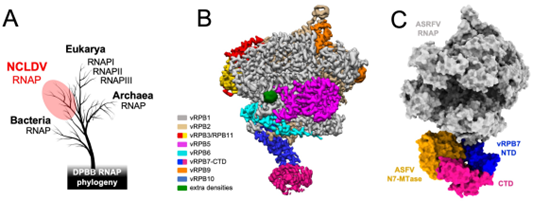
ASFV replicates in the host cell cytoplasm and uses its own machinery to transcribe its genes into mRNAs which are translated into proteins required for virus replication or modulating host cell function. The UCL team have expressed and assembled 8 proteins comprising the ASFV RNA polymerase into an active complex. The cryo-EM structure of this complex molecular machine was determined providing the information to further probe how it functions to regulate ASFV gene expression. Dr Pilotto says: ‘The production of recombinant eukaryotic RNA polymerases remains the bottleneck for structural studies and high-throughput inhibitor screenings. Our success with the ASFV RNAP represents a game-changer in the field’. The ASFV RNAP bears a striking resemblance to RNAPII – and key differences include the fusion of the ‘assembly platform subunits’ and an unusual fusion with a domain related to the eukaryotic mRNA capping enzyme. Together, the changes represent adaptions to streamline the enzyme to serve the virus best: allowing for efficient RNAP biogenesis, and mRNA expression and processing. The availability of a recombinant functional RNA polymerase will facilitate high throughput screening of antiviral compounds to identify compounds with sufficient specificity and selectivity.

This research will be further developed in a recently funded BBSRC collaborative research project between UCL and The Pirbright Institute (led by Drs Linda Dixon and Chris Netherton). This project will identify other accessory virus and host factors involved in regulating the temporal expression of ASFV genes and the packaging of the virus RNA polymerase into particles ready to start a next round of infection. This information is critical to understand the ASFV replication cycle and potential host factors that may limit virus replication.

Evolution and structure of ASFV RNAP. All DPBB RNAP share a common ancestry (A), the cryoEM structure of the 8-subunit ASFV RNAP (B), and model of the RNAP-capping enzyme complex showing the interaction with the CE (N7-MTase in orange, vRPB7 in blue/magenta) 1. ASFV research in the RNAP lab is funded by the BBSRC (BB/X015424/1) and Wellcome Trust (108877/B/15/Z).

Reference

  1. Pilotto, S., Sykora, M., Cackett, G., Dulson, C., and Werner, F. (2024). Structure of the recombinant RNA polymerase from African Swine Fever Virus. Nat Commun 15, 1606. 10.1038/s41467-024-45842-7.

Full paper can be read here.

Posted by Cyndy Thooi in Uncategorised

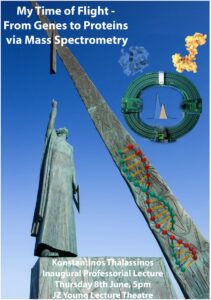
Professor Kostas Thalassinos’s inaugural lecture on Thursday, 8th June

We are delighted to invite you to Professor Kostas Thalassinos’s inaugural lecture, “My Time of Flight – From Genes to Proteins via Mass Spectrometry”, on Thursday 8th June at 5pm in the J Z Young Lecture Theatre (UCL Anatomy Building, Gower Street), followed by a drinks reception.

Tickets are free and everyone is welcome but please sign up via the Eventbrite link so we can know numbers for catering.

https://www.eventbrite.co.uk/e/professor-kostas-thalassinos-inaugural-lecture-tickets-626267401657

Posted by Cyndy Thooi in Uncategorised

Research seminar on Friday, 2nd June: Observing DNA Repair Proteins – Protecting our Genomes from Cancer: From Cells to Single Molecules

This Friday, 2nd June, at 2pm there will be a joint visit from the single-molecule technology company Lumicks and Professor Ben van Houten from the University of Pittsburgh. Professor van Houten will give a talk titled ‘Observing DNA Repair Proteins – Protecting our Genomes from Cancer: From Cells to Single Molecules’ and Lumicks will showcase the applications of their optical tweezers single-molecule technology.

The event will be held in the Darwin Building, Room B15.

Anyone interested is welcome. If you would like to attend, please could you contact g.king@ucl.ac.uk.

Posted by Cyndy Thooi in Uncategorised

David Jones elected as Fellow of the Royal Society

In recognition for his outstanding contributions to science, ISMB member Professor David Jones (UCL Computer Science) has been elected Fellow of the Royal Society. Full article here.

Posted by Cyndy Thooi in Uncategorised

Nobel Prize in Chemistry for Bio-Inspired Catalysts

The Nobel Prize in Chemistry in 2021 has been awarded to German Benjamin List and British David MacMillan.
Prof Stefan Howorka from the ISMB at UCL Chemistry explains: ‘The two researchers have developed a new class of catalysts that are inspired by Nature. Enzymes are widely used in biology as they initiate and specifically control biochemical reactions to achieve the desired stereochemistry while limiting the creation of undesirable by-products. Reconstructing these catalytic functions with smaller and cheaper synthetic units is of considerable scientific and industrial interest. Ideally, synthetic catalysts should also avoid precious metals such as platinum which are not environmentally friendly.
List and MacMillan succeeded independently of each other in developing efficient biomimetic and “green” catalysts. In the late 1990s, List wondered whether amino acids found in the enzymes’ active site would also be able to achieve part of the same catalytic role if added in isolation. As proof-of-principle, List tested the catalytic properties of proline and related compounds in an aldol reaction. The specific question was whether the use of a chiral proline would control the stereochemical outcome of the reaction. Indeed, the chirality of the catalyst controlled which enantiomer of the aldol products was formed.
MacMillan was working in the same field. MacMillan was motivated to develop new catalysts that avoid the widely used metals. Rather, he focused on environmentally harmless and inexpensive organic frameworks that contain -in addition to carbon- oxygen, nitrogen, sulphur or phosphorous. Similar to List, MacMillan also tested chiral versions of his organic catalysts but with a different reaction, the Diels-Alder cycloaddition. The reaction was successful as enantiopure products formed depending on the chirality of the catalysts.
Reflecting the catalysts’ composition and enantioselective control, MacMillan coined the term ‘asymmetric organocatalysis’ This new field has grown dramatically and develops simple, easy-to-manufacture and environmentally friendly catalyst. This has a huge impact in science and industry to produce new pharmaceuticals or molecules that can capture light in solar cells. This year’s Nobel prize and the Nobel prize given in 2018 for ‘the directed evolution of enzymes’ underscore the importance of developing new catalytic tools, Prof Howorka concludes.

References:
J. Am. Chem. Soc. 2000, 122, 2395-2396; J. Am. Chem. Soc. 2000, 122, 4243-4244

Posted by ubcg03u in News, Uncategorised

Rosetrees Trust Grant

The Wallace Group has recently received a 3-year grant from the Rosetrees
Trust
for work on: ‘“Seeing” General Anaesthetics Bound to Sodium
Channels: Using Novel Structure/Function Information for Molecular
Understanding and Design, Enabling Improved Function and Safety
’ – a
collaboration with Professor Hugh Hemmings’ Lab at the Weill Cornell Medical
Centre
in New York.

Posted by ubcg03u in Grants awarded, News, Uncategorised

Professor Steven Perkins’ paper featured on the cover of Biochemical Journal

Professor Steven Perkins (Professor of Structural Biochemistry, UCL) made the front cover of October’s Biochemical Journal (vol. 476, issue 19) with his latest paper:

Crystal structure of zinc-α2-glycoprotein in complex with a fatty acid reveals multiple different modes of protein-lipid binding

A joint project with UCL Medicine and the University of Bedfordshire, it is a combination of work done on Professor Perkins’ new analytical ultracentrifuge, protein crystallography and recombinant proteins.

Citation: Lau, A. M., Zahid, H., Gor, J., Perkins, S. J., Coker, A. R. & McDermott, L. C. (2019) Crystal structure of zinc-α2-glycoprotein in complex with a fatty acid reveals multiple different modes of lipid binding. Biochem. J. 476, 2815-2834.
Posted by ubcg03u in News, Publications, Uncategorised