
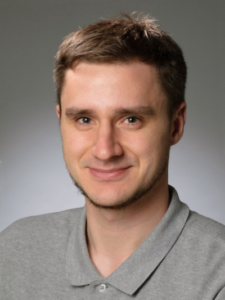
Maxim Igaev
Royal Society University Research Fellow; Senior Research Fellow
Based at the School of Natural Sciences, Birkbeck
Personal website: https://www.bbk.ac.uk/our-staff/9540641
Google Scholar: https://scholar.google.de/citations?hl=de&user=ZqptZTgAAAAJ&view_op=list_works
Kinetochore-mediated microtubule forces in mitosis
The integrity and function of our tissues and organs rely on the control of cell division and the precise timing of the underlying cell cycle. A critical aspect of cell division is the accurate separation of pairs of sister chromatids in mitosis. To achieve this, cellular filaments called microtubules bind to each side of a chromosome pair through multiprotein complexes called kinetochores. Microtubules stochastically switch between growth and shortening phases at their ends, and by remaining coupled to these dynamic ends, kinetochores exploit microtubule polymerisation to transmit forces to the chromosomes. Fundamental paradoxes at the heart of chromosome segregation are how kinetochores track microtubule ends even as they assemble and disassemble, and how these ‘fuzzy’ attachments are stabilised under tensile force.
Supported by a Royal Society University Research Fellowship and an Academy of Medical Sciences Springboard Award, my lab addresses these questions by treating kinetochore-mediated force transduction as a stochastic process in which the kinetochore ‘senses’ the polymerisation state of the microtubule end and selectively stabilises it against spontaneous switches from slow assembly to rapid disassembly. Our aim is to construct a comprehensive physical model of this attachment by integrating advanced multiscale simulation approaches with optical and electron microscopy, biochemistry and live-cell assays through collaborations across the UK and worldwide. Ultimately, we want to understand why the kinetochore–microtubule coupling is extremely conserved across eukaryotes and what physical principles underlie the tension-dependent stabilisation mechanism — potentially transforming our understanding of chromosomal instability and aneuploidy in cancers.
Selected publications
- = co-corresponding author
[1] M Kalutskii, H Grubmüller, V A Volkov§ and M Igaev§. Microtubule dynamics are defined by conformations and stability of clustered protofilaments. PNAS, 122(22): e2424263122 (2025)
[2] L V Bock, M Igaev and H Grubmüller. Single-particle cryo-EM and molecular dynamics simulations: A perfect match. Curr Opin Struct Biol, 86: 102825 (2024)
[3] M Igaev§ and H Grubmüller§. Bending-torsional elasticity and energetics of the plus-end microtubule tip. PNAS, 119(12): e2115516119 (2022)
[4] M Igaev§, C Kutzner, L V Bock, A C Vaiana§ and H Grubmüller§. Automated cryo-EM structure refinement using correlation-driven molecular dynamics. eLife, 8: e43542 (2019)
[5] M Igaev§ and H Grubmüller§. Microtubule assembly governed by tubulin allosteric gain in flexibility and lattice induced fit. eLife, 7: e34353 (2018)