
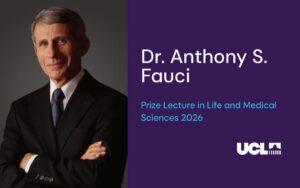
The UCL Prize Lecture in Life and Medical Sciences is a prize awarded annually by UCL since 1997. The annual prize lecture has become one of the pre-eminent series on contemporary science in Europe and staff and students in Life and Medical Sciences are able to nominate their choice of outstanding, innovative researcher
The next UCL Prize Lecture in Life and Medical Sciences will be given by Dr. Anthony S. Fauci FRS, discussing ‘Emerging and Re-Emerging Infectious Diseases: Science, Public Health, and Policy’. This is a rare opportunity to hear from one of the most eminent physician-scientists of our time and we hope you will be able to join for this event.
Infectious diseases are among the leading causes of death and disability worldwide. Against a constant background of established infections, new and old infections inevitably emerge in epidemic form, magnifying the global burden of disease. Although major advances have been achieved in the development of countermeasures such as diagnostics, therapeutics, and vaccine, the ease of world travel and increased global interdependence have added layers of complexity to efforts to contain emerging diseases.
HIV/AIDS, COVID-19, multiple Ebola outbreaks in Africa, H5N1 influenza, and the spread of Mpox, chikungunya virus, Oropouche virus and Zika virus to new locations are examples of infectious disease emergences in the modern world. Some of these diseases have resulted in notable social and economic impacts on a global scale.
Other emerging infections have been less catastrophic but nonetheless have taken a significant human toll and caused public fear, economic loss, and other adverse outcomes. Through the lens of his work with seven U.S. presidents, Dr. Fauci will discuss the history and determinants of infectious disease emergence, efforts to control outbreaks, and progress in the realms of scientific research and policymaking.
The booking link for Dr Fauci’s lecture is now live: Prize Lecture in Life and Medical Sciences | Bloomsbury Theatre
Here, history happens. Find out more about our bicentenary.