
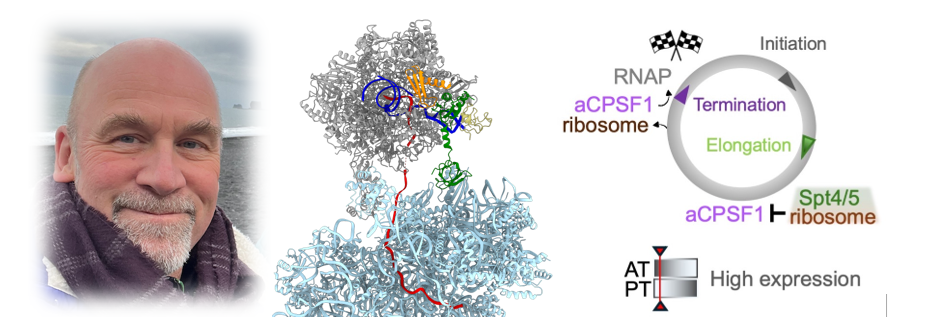
Prof Finn Werner has received an eight-year Wellcome Trust Discovery Award (2025-2033) to support a research program entitled A Holistic View of Gene Expression in Archaea (Figure A). This work will investigate the molecular mechanisms and structural foundations that link RNA polymerase with the pioneering ribosome (B). His laboratory’s genome-scale analyses, which relate dynamic RNA polymerase occupancy to RNA output, have reshaped current understanding of how polymerase movement influences mRNA levels (Blombach, F., et al. Nat Comm 12, 5524 (2021); Smollett, K., et al. Nat Microbiol 2, 17021 (2017). Building on this foundation, the new program will examine transcription within the broader context of translation, allowing us to address fundamental questions about how cells coordinate changes in the transcriptome and proteome and how information flows between the transcription and translation machinery (C) – work that aims to drive a significant advance in the field.
Figure (A) Happy Principle Investigator. (B) S. solfataricus coupled RNAP-ribosome complexes. (C) A previously unrecognised regulatory mechanism in which the ribosome feeds back to RNA polymerase, allowing it to sense and respond to the cell’s metabolic state.
CAS Distinguished Scientist
Prof Finn Werner has been awarded the Chinese Academy of Sciences’ (CAS) Distinguished Scientist Fellowship through the President’s International Fellowship Initiative (PIFI). This fellowship will support deeper collaboration with two leading research groups headed by Profs Jie Li and Chengyuan Wang at the CAS Beijing Institute of Microbiology and the CAS Shanghai Institute of Immunity and Infection. Over the past three years, Finn has worked closely with scientists across China, including at universities in Beijing, Harbin, Qingdao, and Zhengzhou. He views China’s rapidly advancing research landscape and remarkable work ethic as offering valuable opportunities for UK scientists who are looking to engage globally and drive ambitious science forward.